Massachusetts Uber and Lyft Union

Massachusetts Makes History: Uber and Lyft Face Their Biggest Challenge Yet

The First Statewide Rideshare Drivers’ Union in America Is Now a Reality

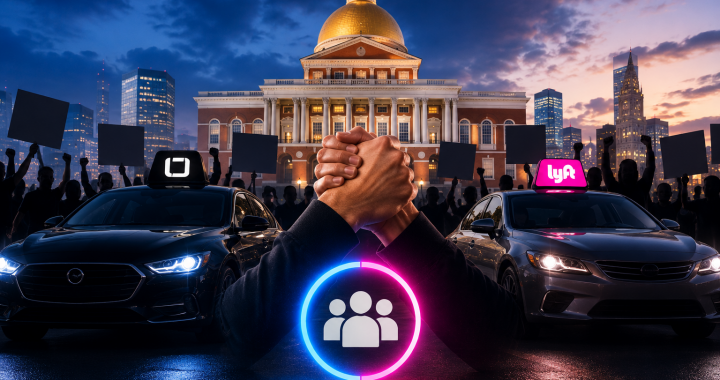
Uber and Lyft drivers in Massachusetts have made history by becoming the first group of rideshare drivers in the United States to gain official state recognition as a union.

The Massachusetts Department of Labor Relations recently certified the App Drivers Union as the representative organization for approximately 70,000 app-based drivers, granting them the authority to engage in collective bargaining with Uber and Lyft.

This unprecedented development could become a turning point for the gig economy and may inspire similar efforts in other states where app-based drivers are seeking greater representation.

The certification follows the approval of Ballot Question 3 by Massachusetts voters in 2024, a measure that granted rideshare drivers the legal right to unionize.

The App Drivers Union, backed by organizations such as the International Association of Machinists and 32BJ SEIU, has stated that its primary goals include improving driver pay, enhancing safety measures, and establishing stronger protections against unfair deactivations.

Industry observers, labor advocates, and rideshare companies across the country are closely watching the outcome, as it could influence the future of app-based work nationwide.>/p>

A Historic Victory for Supporters

Supporters of the union effort view the certification as a major victory for gig workers.

They argue that Uber and Lyft have accumulated significant power through their control of algorithms, pricing systems, and driver deactivation processes, leaving many drivers with limited recourse when disputes arise.

From this perspective, collective bargaining provides drivers with a stronger voice and creates a better balance between large technology companies and the people who provide the service.

Many drivers hope the union will lead to higher earnings, increased transparency, and stronger workplace protections.

The Other Side of the Debate

However, the announcement has also generated concern among many drivers who chose rideshare work specifically because of its independence and flexibility.

Unlike traditional employees, Uber and Lyft drivers are independent contractors. They decide when to work, how many hours to drive, and how much effort they want to invest in generating income.

Millions of drivers originally joined Uber and Lyft as a part-time opportunity to supplement their income. Over time, some discovered they could earn more than they did in traditional jobs and eventually transitioned into full-time driving.

Because of this flexibility, some drivers worry that unionization could gradually push the industry toward a more regulated and less independent model.

Author’s Perspective

In my view, one of the biggest flaws in this debate is the assumption that all drivers have the same goals, work habits, and commitment levels.

The reality is very different.

Some drivers work only a few hours each week for extra income, while others treat rideshare driving as a full-time business. Many experienced drivers learn market patterns, identify the best hours, understand demand cycles, and develop strategies that maximize their earnings.

Not everyone produces the same results or invests the same level of effort.

For that reason, I question whether collective solutions can fairly address the needs of a workforce that is so diverse in terms of commitment, experience, and productivity.

I also believe that most drivers join these platforms fully aware of how the business model works. They understand that earnings are based on time, distance, demand, and platform policies, and they voluntarily choose to participate.

That does not mean the platforms are perfect or beyond criticism. Transparency and accountability are important. However, there is a significant difference between improving the system and fundamentally changing a business model built around independent contracting.

Another concern is the growing political influence that often accompanies unionization efforts.

Historically, labor unions have played an important role in representing workers. At the same time, they have frequently become powerful political organizations capable of influencing legislation and elections.

When an organization represents tens of thousands of people, it inevitably becomes attractive to politicians seeking influence and support.

As a result, some drivers are asking whether future decisions will be driven solely by the interests of drivers or whether broader political agendas may eventually become part of the conversation.

What Happens Next?

Massachusetts has effectively become the nation’s testing ground for the future of app-based work.

If the union successfully improves conditions without reducing the flexibility that drivers value, other states may follow the same path.

However, if the process leads to higher operating costs, reduced opportunities, or increased regulation that limits driver independence, the Massachusetts experiment may serve as a warning rather than a model.

For now, one thing is certain: Uber, Lyft, policymakers, and drivers across the country are watching closely.

The outcome could help shape the future of the gig economy for years to come.

What Do You Think?

Will unionization strengthen drivers’ voices and improve conditions, or could it threaten the flexibility that made rideshare platforms successful in the first place?

Share your thoughts in the comments and follow TaxiSocial for more rideshare news, analysis, and industry updates.

uber Lyft

Uber and Lyft Agree to $328M Settlement Over Alleged Earnings Theft from NY Drivers

Uber and Lyft have agreed to pay a combined $328 million to settle accusations from New York Attorney General Letitia James that the ride-sharing giants were “stealing earnings” from thousands of drivers in New York City over several years. The settlement includes $290 million from Uber and $38 million from Lyft, covering back pay, paid sick leave, proper hiring and earnings notices, and other improvements to drivers’ working conditions.

Attorney General James announced that more than 100,000 drivers throughout New York are entitled to receive settlement funds, with an average payout of $3,280. However, drivers who began after 2017 are not eligible for additional payments. Along with the settlement, Uber and Lyft have agreed to provide new benefits for leave, payment, training, and job support, including up to one week of paid sick leave per year, effective no later than February 29, 2024.

Eligible drivers can file claims to receive the additional funds they are owed. The settlement concludes multi-year investigations into Uber and Lyft, which found that the companies’ policies withheld hard-earned pay from drivers and prevented them from receiving valuable benefits available under New York labor laws.

“For years, Uber and Lyft systematically cheated their drivers out of hundreds of millions of dollars in pay and benefits while they worked long hours in challenging conditions,” said Attorney General James. “These drivers overwhelmingly come from immigrant communities and rely on these jobs to provide for their families.”

Uber responded to the settlement with a statement outlining a new benefits model for its drivers, calling the agreement a win for drivers across New York State. Lyft’s Chief Policy Officer, Jeremy Bird, also praised the settlement, expressing a commitment to providing New York drivers with the independence and full range of benefits available to those in other states like California and Washington.

Forms on the attorney general’s website indicate that Uber drivers seeking back pay must have been employed by the app between November 10, 2014, and May 22, 2017, while Lyft drivers entitled to a portion of the settlement must have driven for the company in New York state between October 11, 2015, and July 31, 2017.

The settlement comes amid rising concerns over fare prices during peak times. Recently, some customers reported Uber and Lyft prices soaring well over $100 during a rush-hour rainstorm that shut down large parts of New York City’s subway system. Over the summer, Uber’s CEO was surprised by a $51.69 fare for a less-than-three-mile drive in Manhattan.

major Adams

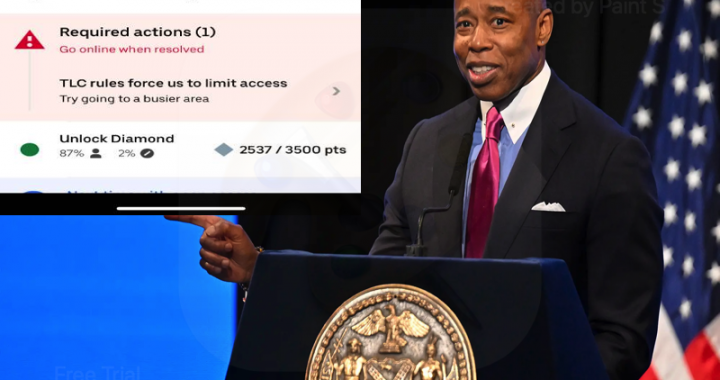
Mayor Adams Strikes Deal With Uber, Lyft to Boost Driver Earnings by Cutting Down Lockouts

New York City Mayor Eric Adams, alongside New York City Taxi and Limousine Commission (TLC) Commissioner David Do, announced that the city has reached agreements with rideshare giants Uber and Lyft to significantly reduce access restrictions—commonly known as “lockouts”—that have led to lower earnings for the city’s for-hire drivers since mid-May.

“Uber and Lyft drivers help us get where we need to go, and now it’s our turn to help them earn a decent wage,” said Mayor Adams. “We’ll always fight for working-class New Yorkers, and this deal will put money back into the pockets of hard-working drivers, ensuring they can continue to afford living in the greatest city in the world.”

“Our goal is to provide relief to the city’s drivers as quickly as possible, without the delays and potential conflicts of a lengthy rulemaking process,” said TLC Commissioner Do. “We’ve prepared a strong rule package to deter access restrictions, and we’re ready to implement it if necessary.”

New York City was the first in the nation to guarantee minimum pay for for-hire vehicle drivers, ensuring they are compensated for time spent between trips and discouraging rideshare companies from oversaturating the market with drivers. Additionally, the Adams administration introduced the first minimum pay rules for delivery workers, resulting in a 64 percent pay increase when comparing the first quarter of 2024 to the first quarter of 2023.

Under the new agreement, Uber will begin phasing out access restrictions for drivers using its platform, aiming to eliminate them entirely by Labor Day, provided Lyft maintains an annual company utilization rate (the time drivers spend with passengers) of at least 50 percent. This rate decreases when companies onboard too many drivers. Both companies will also halt new driver onboarding to increase utilization rates, thereby providing more work for existing drivers. Lyft will minimize lockouts while the onboarding pause is in effect.

Supporting the city’s taxi and for-hire drivers has been a key focus of Mayor Adams’ administration. Shortly after taking office, the administration launched the Medallion Relief Program Plus, providing $468 million in debt relief for over 2,000 medallion owners. In late 2022, the TLC approved the first taxi meter fare increase in 10 years to secure a pay raise for taxi drivers. Additionally, the Adams administration successfully secured pay increases for Uber and Lyft drivers in March 2023 and February 2024. In line with the Green Rides Initiative—which mandates that all rideshare vehicles be zero-emissions or wheelchair accessible by 2030—the administration also lifted the licensing pause on electric vehicle licenses, enabling nearly 10,000 drivers to own their businesses and save thousands in rental costs.

“This agreement will allow us to immediately reduce and aim to soon eliminate platform access restrictions for existing drivers,” said Josh Gold, senior director of policy and communications at Uber.

“Lyft supports an environment where New York City drivers can earn whenever and however they want while driving on the Lyft platform,” said Megan Sirjane-Samples, director of public policy at Lyft. “We never want to impose supply controls, and we’ll continue working with TLC in the best interest of drivers.”