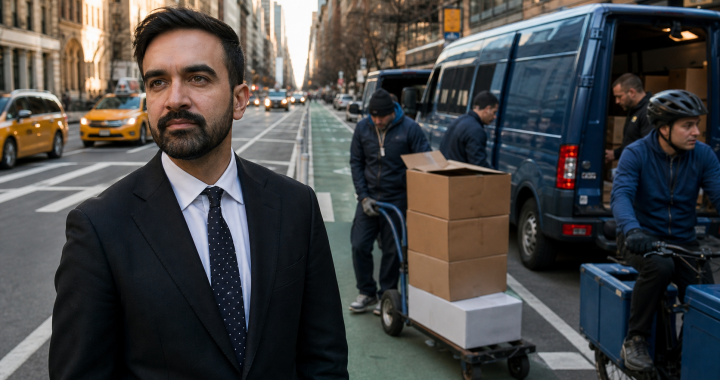
The proposal would require certain distribution centers to directly employ their delivery workers, strengthen road-safety training and assume greater responsibility for what happens on city streets
New York City Mayor Zohran Mamdani has publicly endorsed the Delivery Protection Act, a proposal that seeks to transform the model used by Amazon and other large companies for last-mile deliveries throughout the city.
The bill, identified as Intro 518-2026, was introduced by Council Member Tiffany Cabán. Its central goal is to prevent operators of certain distribution facilities from avoiding labor and safety responsibilities through subcontractors.
Although the mayor’s support increases political pressure for its passage, the measure is not yet law. According to the New York City Council’s official record, the bill remains in committee following a hearing held on April 9, 2026.
What Would the Proposal Change?
Amazon uses a network of companies in New York known as Delivery Service Partners, or DSPs. These companies hire the drivers who deliver packages using vehicles, electric bicycles and other forms of transportation associated with the Amazon brand.
Legally, many of these delivery workers are employed by subcontractors rather than directly by Amazon.
The proposal would require certain warehouses and last-mile facilities to obtain a license from the Department of Consumer and Worker Protection. It would also require the operator of each covered facility to directly employ the people who perform its core warehouse and delivery services.
Among the proposal’s most important provisions are:
- A license for each last-mile facility, carrying an annual fee of $500 and a two-year term.
- Direct employment of warehouse workers and delivery drivers who work more than eight hours during a 30-day period.
- A general prohibition on using staffing agencies or subcontractors to perform these core services.
- Hiring preference for workers currently employed by a subcontractor if their contract ends because of the new law.
- Thirty days’ notice before termination, except in cases of serious misconduct.
- At least six hours of training covering labor rights, defensive driving, pedestrian safety, bike lanes, heat stress and injury prevention.
The direct-employment requirement would begin approximately one year after the legislation became law. Some existing contracts could receive extensions lasting up to two years.
The Argument From Mamdani and Labor Unions
Supporters of the bill argue that Amazon controls a significant portion of delivery routes, quotas, technology and operating standards while shifting legal responsibility for workers and accidents to its DSPs.
The Teamsters union says this model allows a corporation to exercise control over delivery workers without fully assuming the obligations of an employer. The union also argues that direct employment would make it easier for workers to organize and assert their rights.
The Mamdani administration has connected the labor issue to road safety. The proposal includes training on stopping safely along congested roads, respecting bike lanes and protecting pedestrians and other road users.
An analysis cited during the debate found increases in crashes around several recently opened distribution facilities. That finding should be interpreted carefully, however: a statistical association does not by itself prove that the warehouses caused all those crashes.
Amazon Warns About Jobs and Possible Cost Increases
Amazon opposes the proposal. In its testimony before the City Council, the company said it works with more than 40 DSPs employing approximately 5,000 people in New York City.
According to figures provided by the company, those drivers earn an average of nearly $24 per hour. Amazon argues that eliminating the subcontracting model would threaten these small businesses and could force the company to relocate distribution facilities outside the five boroughs.
The company also says it operates more than 800 electric cargo bicycles in Manhattan and Brooklyn, reducing the number of delivery vans needed to complete its routes.
Business organizations such as the Partnership for New York City warn that higher operating costs could result in more expensive deliveries. They also point to a possible unintended consequence: if warehouses move outside the city, delivery vehicles would have to travel farther, potentially increasing traffic and emissions.
What Does This Mean for New York Taxi and For-Hire Drivers?
The bill would not directly change TLC licensing requirements, taxi fares, insurance rules or the regulations governing taxi and app-based drivers.
Its effect on the industry would be primarily indirect.
If the regulation succeeds in reducing overly aggressive routes, dangerous parking and stops inside bike lanes, it could improve safety and traffic flow on streets shared by taxis, delivery workers, cyclists and pedestrians.
However, if Amazon responds by moving operations outside the city, delivery vans may have to travel longer distances from suburban and industrial areas. That could mean more vehicle miles, greater congestion at city entry points and additional pressure on the streets where taxi drivers work.
It also remains unclear what would happen with electric cargo bicycles. These vehicles can replace vans and reduce emissions, but they require clear rules concerning their dimensions, operation, parking and use of bike lanes.
A Dispute Over Who Should Be Held Responsible
The debate extends beyond Amazon. The fundamental question is who should be held responsible when a large corporation controls an operation but another company is officially listed as the workers’ employer.
Cabán and Mamdani’s proposal seeks to shift that responsibility to the primary facility operator. Amazon responds that the change could destroy small businesses, eliminate jobs and make deliveries more expensive.
Both possibilities deserve attention. Subcontracting can conceal where responsibility truly lies, but a poorly designed transition could also harm the same workers the legislation is intended to protect.
For now, there is no immediate change for consumers, delivery workers or taxi drivers. The proposal must advance through the City Council, receive a vote and be signed by the mayor before becoming law.
What is clear is that New York City is preparing for a major battle over the future of deliveries, road safety and the power of large corporations on its streets.