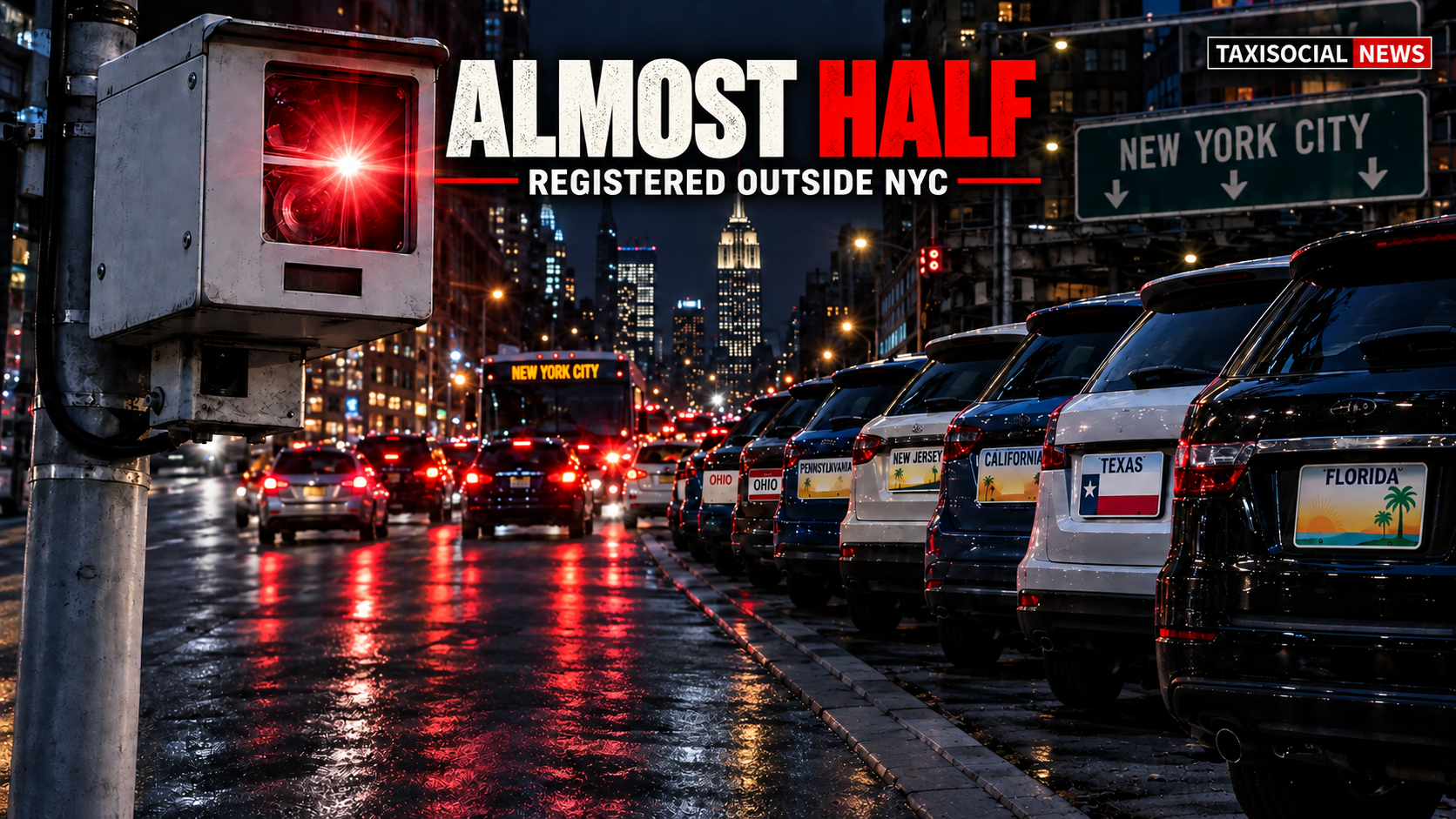
The city has multiplied cameras, fines, and lower speed limits for people whose vehicles are properly registered. Yet for years, it has allowed fake plates, questionable out-of-state registrations, and false addresses to undermine that same enforcement system.
By the TaxiSocial Editorial Team
This story begins in Sweden, but our protest is directed at New York.
In 1997, the Swedish Parliament adopted Vision Zero based on a principle that is difficult to dispute: no traffic death or serious injury should be accepted as inevitable. Drivers must obey the law, but authorities also have a duty to build a safe system and correct it when it fails.
New York adopted that philosophy in January 2014. Since then, the city has redesigned streets, reduced driving space, installed cameras, lowered speed limits, and expanded the ways drivers can be penalized.
The promise was safety for everyone.
Our complaint is that responsibility is not being demanded equally from everyone.
Vision Zero Arrived With More Surveillance
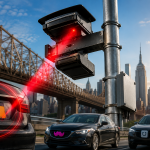
In November 2014, the citywide default speed limit dropped from 30 to 25 miles per hour. The speed-camera program began expanding around schools. In 2019, it was authorized to operate in 750 school zones, and since August 2022, the cameras have operated 24 hours a day, seven days a week.
In 2024, Sammy’s Law allowed the city to lower the limit to 20 miles per hour on certain streets and to 10 miles per hour in some shared spaces.
Each new measure has been presented as a safety tool. But for people who work and drive legally — taxi drivers, delivery workers, rideshare drivers, and residents who depend on their cars — the daily reality also means more cameras, more restrictions, more fines, and less room to make a mistake.
A properly registered vehicle is completely visible. The city knows the owner, the address, and the insurance information. A camera can automatically send that person a speeding, red-light, or bus-lane violation. Toll systems can also locate the vehicle. If the owner accumulates debt or loses insurance coverage, the consequences are attached directly to the registration.
That driver cannot disappear.
Meanwhile, another vehicle can remain on the same street with a fake, altered, covered, expired, or mismatched plate. It may also be registered in another state using an address that does not reflect where the vehicle is actually kept and driven.
That is the unequal treatment TaxiSocial is protesting.
Vision Zero’s Results Do Not Justify Ignoring Inequality
Official data indicates that daily speeding violations fell by 94 percent at locations with cameras. Locations where cameras were installed more recently experienced 14 percent fewer injuries and deaths than comparable locations without them.
Acknowledging those figures does not mean defending the way authorities manage the entire system. A policy can produce benefits while still operating within an unfair structure.
Authorities use these results to justify more cameras and lower speed limits. TaxiSocial has a question in response: why do they not apply the same level of technology, persistence, and resources to identifying people who use fake plates, mismatched registrations, or false addresses?
A camera works only when a license plate leads to a real person. If a vehicle is effectively untraceable, the city may photograph the violation without being able to hold anyone accountable.
The law-abiding driver pays because that driver is visible. The evader benefits precisely because the evader manages to hide.
What We See on the Streets
Those of us who spent years driving at night remember a more consistent traffic-enforcement presence patrolling blocks, checking vehicles, and addressing parking violations.
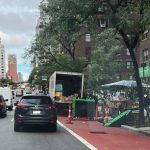
Our experience today is different. In parts of the Bronx and Manhattan, it is possible to drive through blocks at night and see numerous vehicles with out-of-state plates parked for extended periods. During informal street counts, we have observed more than ten such vehicles on one side of a single block.
That count is not a scientific study, and it does not prove that every vehicle is illegal. But it should not be dismissed as though workers and residents do not understand what is happening in their own neighborhoods.
When the same plate appears night after night for weeks or months, authorities should have a way to determine whether it belongs to a legitimate visitor or to someone who permanently lives in New York but refuses to meet local obligations.
The responsibility to investigate cannot be shifted to ordinary residents. It belongs to the DMV, the Police Department, the Department of Finance, insurance companies, and transportation agencies.
The City Council Confirmed That the Problem Is Real
In 2025, the New York City Council’s Oversight and Investigations Division examined more than 3,500 parked vehicles across 50 selected blocks in the five boroughs.
Among 768 vehicles observed without New York plates, 530 had plates that correctly matched the vehicle. But 126 — or 17 percent — displayed plates that returned no valid registration or were registered to a different vehicle. Another 48 displayed out-of-state temporary or dealer plates, and 64 had no plates.
The survey deliberately focused on areas with a high share of violations associated with out-of-state plates. It therefore does not represent the entire city. But that limitation does not erase what investigators found: vehicles that could not be properly identified were occupying and using public space.
Vehicles with mismatched plates or no valid registration owed an average of $667.48 in outstanding fines. Vehicles with legitimate out-of-state plates owed an average of $268.08.
The first group had paid only 16 percent of its fines. Properly identified vehicles had paid 63 percent.
They had also accumulated 49 percent more school-zone speed-camera violations and 74 percent more violations for blocking fire hydrants.
We are not imagining this problem. It has been documented by the government itself.
An Out-of-State Plate Does Not Prove Fraud, but It Should Not Prevent an Investigation
TaxiSocial is not claiming that every vehicle with a New Jersey, Pennsylvania, Florida, or other out-of-state plate is illegal. Tourists, visitors, students, and residents of other jurisdictions have the right to drive in New York with valid documents.
But that fact cannot become an excuse for authorities to look the other way.
The law provides that a person who establishes New York residency has 30 days to register a vehicle in the state. In general, that person must also exchange a valid out-of-state driver’s license within the same period.
The New York State Department of Financial Services recognizes rate evasion when a resident falsely claims that a vehicle is primarily garaged or driven outside the state. That lie can artificially reduce the cost of insurance.
A resident who pays a properly calculated premium is forced to compete with someone who uses a false address to pay less. Both use the same streets, search for parking on the same blocks, and create risk within the same city, but only one pays the actual cost.
That is not legitimate saving. It is exploiting the system and shifting the cost to those who comply.
The Green Light Law Also Deserves Scrutiny, Not Silence
The Green Light Law took effect in December 2019 and allowed New York residents to apply for a standard driver’s license regardless of immigration status.
TaxiSocial questions why authorities expand access to driving without presenting the public, with equal clarity, with an adequate plan for congestion, parking, driver education, insurance, and enforcement capacity.
The available evidence does not allow us to honestly claim that the law, by itself, caused an increase in crashes, congestion, or license-plate fraud. But that does not prevent us from demanding that the state study and publish its effects on the number of drivers and vehicles.
Our criticism is directed at a government that adopts policies without adequately explaining all their secondary effects and then forces residents who comply with the law to absorb the costs.
A lack of data should not be used to invent causation, but neither should it be used to silence uncomfortable questions.
Special Operations Are Not a Substitute for Daily Enforcement
Authorities emphasize that a joint task force conducted 100 operations between March 2024 and August 2025. Those actions resulted in 5,343 vehicles being towed for suspended registrations or fraudulent, obstructed, or altered plates.
Those numbers do not disprove our protest. They strengthen it.
If more than five thousand vehicles could be removed during 100 operations, then the problem was widespread, visible, and had been growing for some time. It also proves that the government has the tools to act when it decides to assign personnel and resources.
The question is why the problem was allowed to reach that point. Where was daily enforcement while these vehicles multiplied? Why does a law-abiding driver automatically receive a speeding ticket while a vehicle with a false identity can remain parked for weeks?
A press conference and an occasional enforcement operation are not substitutes for a consistent presence in our neighborhoods.
2025–2026: More Promises, but the Inequality Continues
New York ended 2025 with 205 traffic deaths, the lowest annual number since recordkeeping began in 1910. That represented a 31 percent decline since the beginning of Vision Zero.
In September 2026, the city announced Vision Zero Reimagined: a ten-year plan containing more than 100 commitments, new safety interventions, and additional tools aimed at dangerous drivers.
TaxiSocial warns that we will not accept another decade in which the main solution is to monitor and charge more money to drivers who are already identified.
Before expanding automated punishment even further, the city must ensure that all vehicles can be traced, are properly insured, and are subject to the same rules.
What We Demand
- Regular nighttime enforcement in areas with a high concentration of suspicious vehicles, based on objective indicators rather than a driver’s appearance.
- Verification of plates, registrations, VINs, and insurance when legal discrepancies exist.
- Real-time coordination with motor vehicle departments and insurers in other states.
- Investigations into false addresses and businesses that sell services designed to evade registration requirements.
- Public data on vehicles inspected, legitimate registrations, fraud detected, towing, repeat offenses, and fines collected.
- Enforcement of the 30-day registration requirement for people who establish New York residency.
- Public evaluations of new licensing and mobility policies before additional costs are shifted onto residents.
- The same level of accountability for private vehicles, taxis, rideshare platforms, commercial fleets, and government vehicles.
Vision Zero began with the declaration that no death should be considered inevitable.
TaxiSocial adds that unequal treatment should never be considered acceptable.
We are not protesting because we want dangerous streets. We are protesting because safety applied selectively is no longer justice.
A legitimate out-of-state plate is not the enemy. The enemy is the fraud authorities allow to grow and the impunity ultimately paid for by the driver who follows the rules.
Same streets. Same responsibility. One law for everyone.
Sources
- Swedish Transport Administration: The Origin of Vision Zero
- New York City Vision Zero Action Plan, 2014
- NYC DOT: History and Results of the Speed-Camera Program
- NYC DOT: Implementation of Sammy’s Law
- New York City Council: Plate and Switch Report
- Results of 100 Joint Ghost-Plate Enforcement Operations
- New York DMV: Vehicle Registration Requirements for New Residents
- New York DMV: Driver’s Licenses and New Residents
- NYC DOT: 2025 Traffic-Safety Results
- Vision Zero Reimagined, September 2026